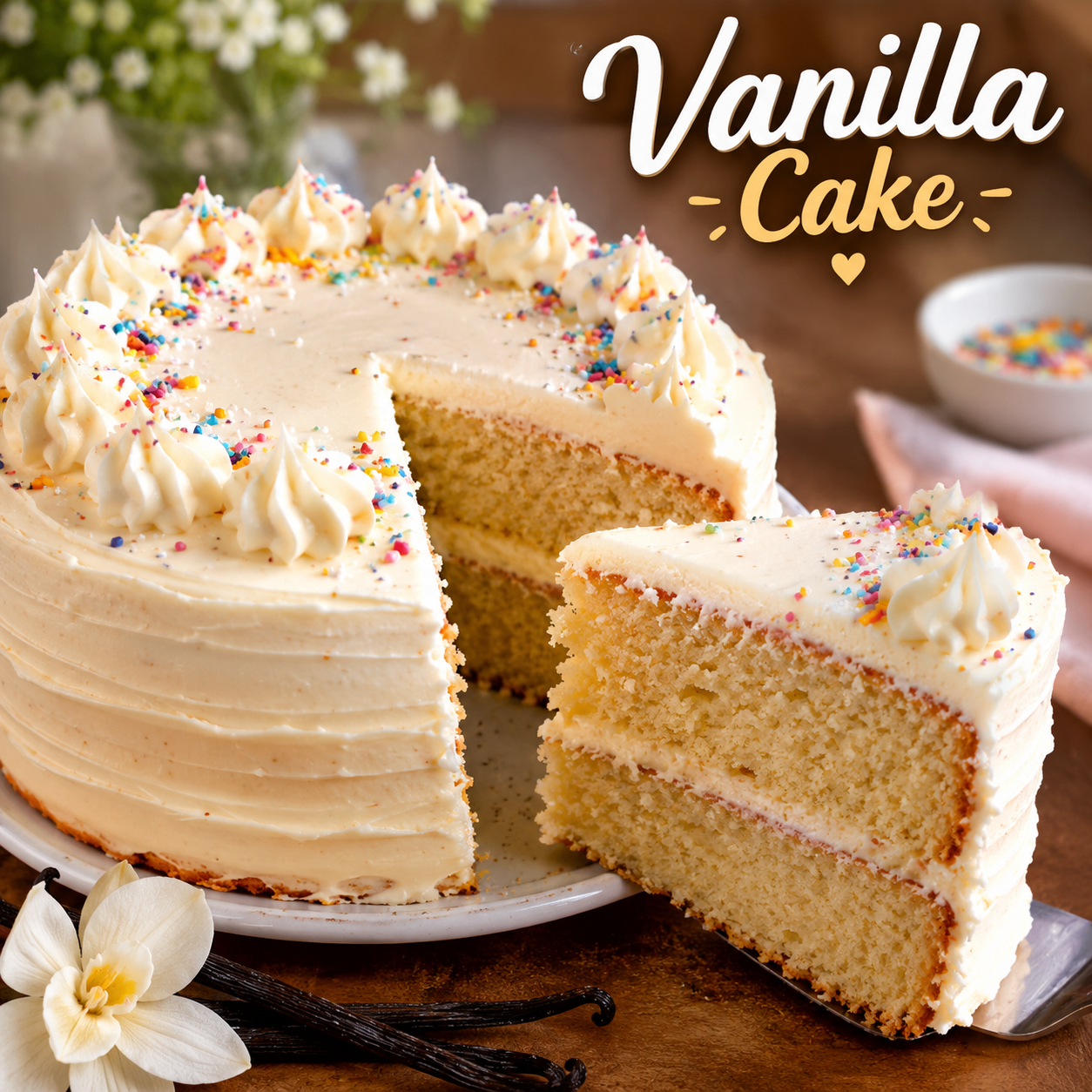
The candles are out and everyone leans in. Then the first fork slides through a slice of vanilla cake so soft that it barely resists, and the table goes quiet. That hush is the sound of a great cake.
This vanilla cake was built for that moment. It has a tender buttermilk crumb, a cloud of vanilla buttercream and a sprinkle-happy top. Better still, it comes with straight answers to the questions bakers keep asking: is it the same as white cake, what goes between the layers, and how long does it stay fresh?
Is vanilla cake the same thing as white cake?
Think of three cousins at one family table. Vanilla is the flavor they all share. White cake is the pale one, made with egg whites only. Yellow cake is the golden one, made with whole eggs.
So, strictly speaking, they overlap. Yet the yolks change the story: they make a cake taste richer, while egg whites keep it light and fine. This recipe uses three whole eggs, which puts it in the golden camp, with a soft cream-colored crumb and plenty of vanilla.
What is the secret to a good vanilla cake?
Great vanilla cake rarely comes from a magic trick. It comes from three quiet habits.
1. Weigh the flour
This cake is rich in fat and liquid, so a small slip in the flour can tip the balance. A kitchen scale takes the guesswork out, and it costs very little.
2. Warm up your ingredients
Butter, eggs and buttermilk should all sit at room temperature before you begin. As a result, the batter mixes smoothly instead of looking curdled.
3. Trust real buttermilk
Store-bought buttermilk is thicker than a homemade stand-in. Since this recipe uses a generous amount, it is worth buying the real thing. Otherwise, see the note below about adjusting the quantity.
What you’ll need for this vanilla cake
- 300 g all-purpose flour
- 25 g cornstarch
- ½ tsp baking soda
- 1 tsp baking powder
- ½ tsp salt (skip it if you use salted butter)
- 113 g unsalted butter, room temperature
- 105 g neutral vegetable oil (canola works well)
- 332 g granulated white sugar
- 3 large eggs, room temperature
- 1 ¼ tbsp vanilla extract
- 1 tsp white vinegar
- 337 g buttermilk, room temperature
- 340 g softened butter
- 375 g powdered sugar
- 1½ tsp vanilla extract
- 1½ tbsp milk (or thick cream)
How to make a simple moist vanilla cake
What to fill a vanilla cake with
Vanilla cake is a blank canvas, so you have three easy routes.
- Keep it classic. Use the same vanilla buttercream between the layers, as shown in the photo.
- Add some fruit. A thin fruit filling under the buttercream is a popular pairing with vanilla cake.
- Go lighter. If American buttercream feels too sweet, try a Swiss meringue or French buttercream instead.
How long does vanilla cake last? (The 4 day cake rule)
Bakers often follow the “4 day cake rule”: eat a cake within four days of baking. Advice varies, so treat it as a friendly guideline.
A buttercream cake keeps for about one to two days in a cool spot, covered. After that, refrigerate it, and take it out 30 to 60 minutes before serving so the frosting softens.
Planning a party? You can wrap the unfrosted layers and freeze them for up to a month. Frozen layers are also easier to frost.
Tips, common mistakes and variations
- Use grams. Measuring the flour by cups is the quickest way to change the balance of this recipe.
- Check your butter. If it is salted, leave the salt out of the cake.
- Skip the shortcuts. Frosting a warm cake makes the buttercream slide off.
- Try cake flour. Use 325 g in place of the all-purpose flour and cornstarch.
- Make it yours. Add rainbow sprinkles for a party, or keep the top plain for a quieter look.
Let us know how your vanilla cake turned out and what you filled it with. Hungry for
Vanilla Cake: 9 Easy Steps to a Wonderfully Moist Crumb
vanilla cake has a tender buttermilk crumb and creamy vanilla buttercream. Get the easy recipe, filling ideas and storage tips for any party.
Ingredients
Dry ingredients
- 300 g all-purpose flour
- 25 g cornstarch
- ½ tsp baking soda
- 1 tsp baking powder
- ½ tsp salt (skip it if you use salted butter)
Wet and rich ingredients
- 113 g unsalted butter, room temperature
- 105 g neutral vegetable oil (canola works well)
- 332 g granulated white sugar
- 3 large eggs, room temperature
- 1 ¼ tbsp vanilla extract
- 1 tsp white vinegar
- 337 g buttermilk, room temperature
Vanilla buttercream
- 340 g softened butter
- 375 g powdered sugar
- 1½ tsp vanilla extract
- 1½ tbsp milk (or thick cream)
Instructions
Set the stage.
- Heat the oven to 165 °C (329 °F) with the fan on. Without a fan setting, use 175 °C (347 °F). Then grease and line two deep 8-inch (20 cm) round pans.
Whisk the dry team.
- Whisk the flour, cornstarch, baking soda, baking powder and salt together in a bowl. Set it aside.
Cream the butter, oil and sugar.
- Beat the room-temperature butter, oil and granulated sugar until the mixture looks light and creamy.
Bring in the eggs.
- Beat in the eggs one at a time. Then mix in the vanilla extract and white vinegar.
Alternate flour and buttermilk.
- Add the dry mixture and the buttermilk in turns, starting and ending with the dry mixture. Stir only until everything just comes together, so the crumb stays tender.
Bake.
- Divide the batter between the pans and bake for about 30 to 35 minutes. Start checking at 30 minutes: the cakes are done when a toothpick in the center comes out clean.
Cool completely.
- Let the layers cool all the way before you frost them. A warm cake melts buttercream.
Whip the buttercream.
- Beat the softened butter until creamy. Add the powdered sugar, vanilla extract and milk, then beat until smooth and fluffy.
Stack, frost and sprinkle.
- Spread a generous layer of buttercream on the first layer and top it with the second. Cover the top and sides, then add sprinkles if you like.