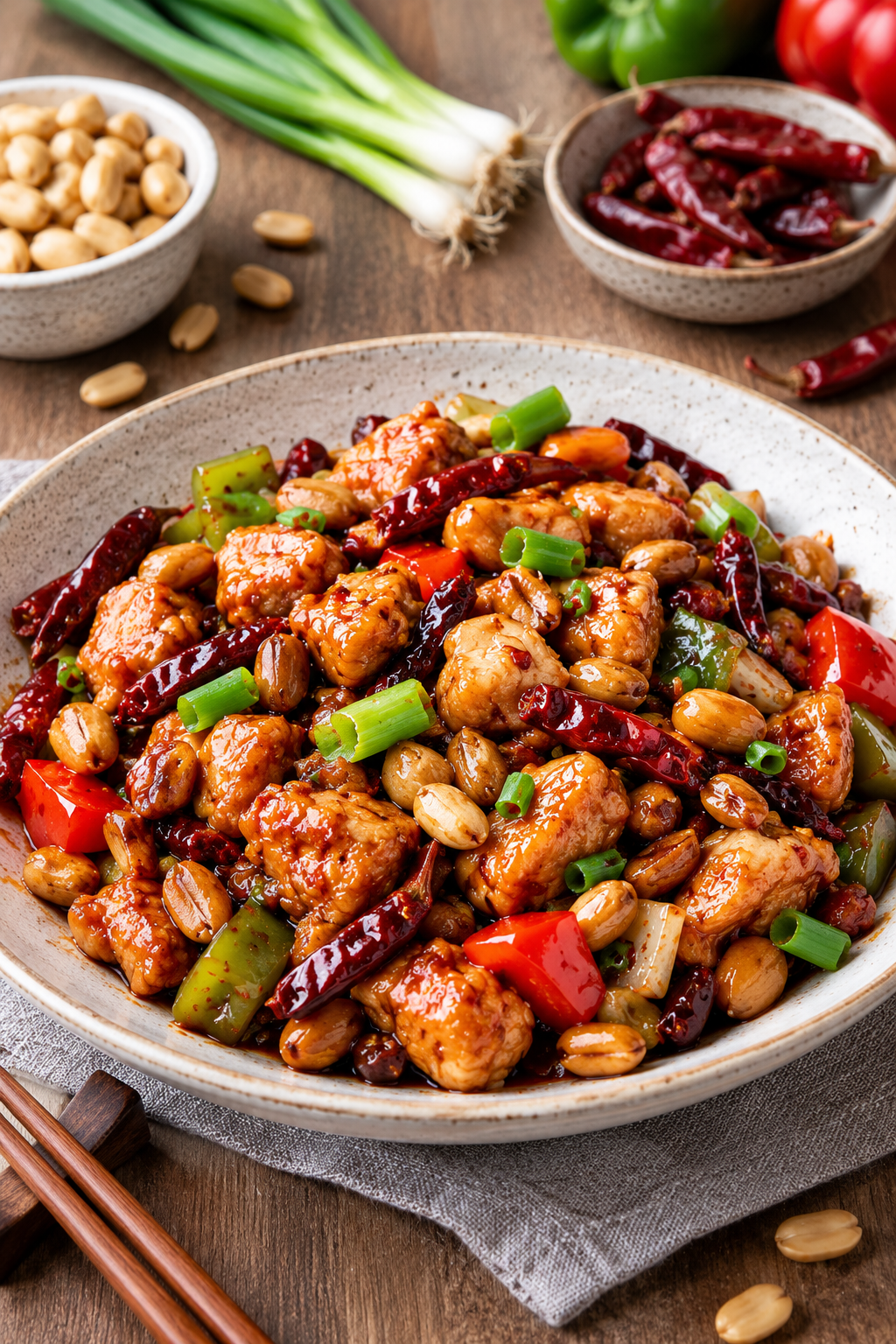
The answer involves a Qing dynasty official, a chef who fled across the Taiwan Strait, a spice that was kept out of the United States for nearly four decades, and one very persistent chicken. By the end, you’ll know exactly what you’re ordering, and you’ll have an easy kung pao chicken recipe to cook your own tonight.
So, Who Was Kung Pao, Anyway?
Let us begin in Sichuan Province, in southwestern China. In Mandarin, the dish is known as “Gongbao Jiding” (gōng bǎo jī dīng)—a name that carries a small mystery. The term “Gongbao” is an honorary title, roughly translating to “Guardian of the Palace,” and is associated with Ding Baozhen, a Qing Dynasty official who governed Sichuan Province in the late 19th century. As for “Jiding,” it has an ancient origin meaning “diced chicken.” Since “Ding” was also the surname of that official, the name itself incorporates a clever play on words.
Did the governor really love this dish enough to lend it his title? Nobody can say for sure. One food writer notes there’s no particular evidence for or against the story. The legends are wonderfully contradictory, though. Cookbook author Fuchsia Dunlop says some claim Ding brought the dish from his home province of Guizhou, others that he tasted it in a modest restaurant while out in He wore modest clothing as a clever ploy to see how his subjects truly lived; other accounts—which are somewhat less convincing—suggest that his cook used to finely chop the chicken because the ruler suffered from dental problems.
Sichuan, Shandong, and Guizhou also each cook it differently, and each has a fair claim to it.
The dish even got caught up in politics. During the Cultural Revolution, its link to an imperial official made it a problem, so it was renamed “fast-fried chicken cubes” or “chicken cubes with seared chiles.” It didn’t get its name back until the 1980s.
The Great Peppercorn Plot Twist
From 1968 until 2005, the United States banned imports of Sichuan peppercorns over fears they could carry a citrus disease. Enforcement was loose until 2002, but the effect was real: the tingly, mouth-buzzing spice of Sichuan cooking was hard to find. The ban was lifted, but a requirement remained in place to subject peppercorns to heat treatment before importation—a process many believe diminishes their pungency.
In the meantime, American kitchens made do. The Americanized Kung Pao leans on bell peppers, peanuts, and a sweeter, thicker sauce, while the Sichuan original is drier and built around that special peppercorn. Same name, very different personality.
Enter the General
Now for the other contender. General Tso’s chicken is named after Zuo Zongtang (also spelled Tso Tsung-t’ang), a real 19th-century general from Hunan province.
The dish traces back to Peng Chang-kuei, a Hunanese chef who fled to Taiwan with the Nationalist government in 1949 and cooked for official banquets in Taipei. He is widely credited with inventing it there in the 1950s, and it is said that he adopted the title “General” for himself because both he and the general hailed from the same town in Hunan Province..
Here’s the twist: Peng’s original wasn’t sweet. By his own account, it was Hunanese in taste and made without sugar. In the early 1970s, a New York chef named T.T. Wang, of Shun Lee Palace, visited Peng’s Taipei kitchen, came home, and put a version on his own menu (first called “General Ching’s chicken”). His take was crispier and a good deal sweeter, and that’s the one that won over American diners.
When Peng was later shown photos of American General Tso’s in the documentary The Search for General Tso, he dismissed the whole thing as nonsense.
Kung Pao vs. General Tso’s, Side by Side
| Kung Pao Chicken | General Tso’s Chicken | |
|---|---|---|
| Where it started | Sichuan, China (with a Qing-era legend attached) | Taipei, Taiwan, by a Hunanese chef, then reinvented in New York |
| Technique | Quick stir-fry | Deep-fried, then coated in sauce |
| Flavor | Savory, tangy, a little sweet, with a smoky edge | Sweet, tangy, sticky |
| The crunch | Peanuts | Crispy coating (no peanuts) |
| The heat | Chilies, plus a numbing tingle from Sichuan pepper in authentic versions | Gentle, sweet-forward heat |
Generally, Kung Pao. General Tso’s is built around sweetness, with only a gentle nudge of spice. The real answer depends on whoever’s holding the wok, which is exactly why cooking it yourself is so satisfying.
Kung Pao usually wins, though neither is a salad. It’s stir-fried instead of deep-fried, and the peanuts and veggies add some substance. Both can be high in sodium, especially from a restaurant. At home, it’s entirely up to you—you can control the amount of oil, salt, and sugar exactly as you like..
Kung Pao Chicken Recipe: Quick & Easy
This is the friendly, American-style version: hoisin and sugar in the sauce, bell peppers and celery in the mix, and a gentle kick from crushed red pepper. It’s the takeout version many of us grew up on, and once the chicken has marinated, the cooking itself takes just minutes.
- 2 lbs chicken breast, cut into small pieces
- 1/4 tsp salt
- 1/4 tsp pepper
- 2 tbsp soy sauce
- 3 tsp corn starch
- 2 tbsp rice vinegar
- 3 tbsp vegetable oil
- 4 cloves garlic, minced
- 1/3 cup roasted peanut
- 1 stalk celery, sliced
- 1/2 medium green bell pepper, diced
- 1/2 medium red bell pepper, diced
- 3 stalks green onion, sliced
- 1 tbsp soy sauce
- 1 tbsp hoisin sauce
- 1 tbsp sesame oil
- 2 tbsp sugar
- 2 tbsp white wine
- 2 tbsp water
- 1/4 tsp ground ginger
- 1/4 tsp crushed red pepper
- 1 tbsp corn starch
Method
Put the chicken in a bowl with the salt, pepper, soy sauce, corn starch, and rice vinegar. Mix until every piece is lightly coated, cover, and refrigerate for about an hour. This rest keeps the chicken tender and gives it flavor all the way through.
While the chicken rests, whisk the soy sauce, hoisin, sesame oil, sugar, white wine, water, ground ginger, crushed red pepper, and corn starch in a small bowl until smooth. Stir it once more just before it goes in the pan, because the corn starch sinks.
Set a wok or large skillet over high heat and add the vegetable oil. Add the marinated chicken and cook until browned and cooked through, then move it to a plate. With 2 pounds of chicken, two batches work better than one crowded pan (use the oil a little at a time).
In the same pan, add the garlic, celery, and green and red bell peppers. Stir-fry just until they smell wonderful and turn slightly tender while staying crisp.
Return the chicken to the pan, add the peanuts and green onions, and pour in the sauce. Keep stirring until the sauce thickens and clings to everything.
Spoon it over steamed jasmine rice or chewy egg noodles while it’s hot.
Tips for a better stir-fry
- Prep first. Once the pan is hot, everything happens fast, so chop and measure before you start.
- Keep the heat high and keep stirring. That’s how you get browned chicken and bright, crisp vegetables.
- Add the peanuts late. They stay crunchy instead of turning too dark.
- Want the real Sichuan tingle? If you can find Sichuan peppercorns, toss a few into the pan. They’re optional, but they bring back the numbing buzz from the story above.
Easy variations
- Vegetarian: swap the chicken for firm tofu or sautéed mushrooms.
- Other proteins: try shrimp, beef, or pork, and adjust the cooking time so they stay tender.
- More heat: add extra crushed red pepper or a few whole dried red chilies, like the ones in the photo.
- Less heat: use a little less crushed red pepper.
Print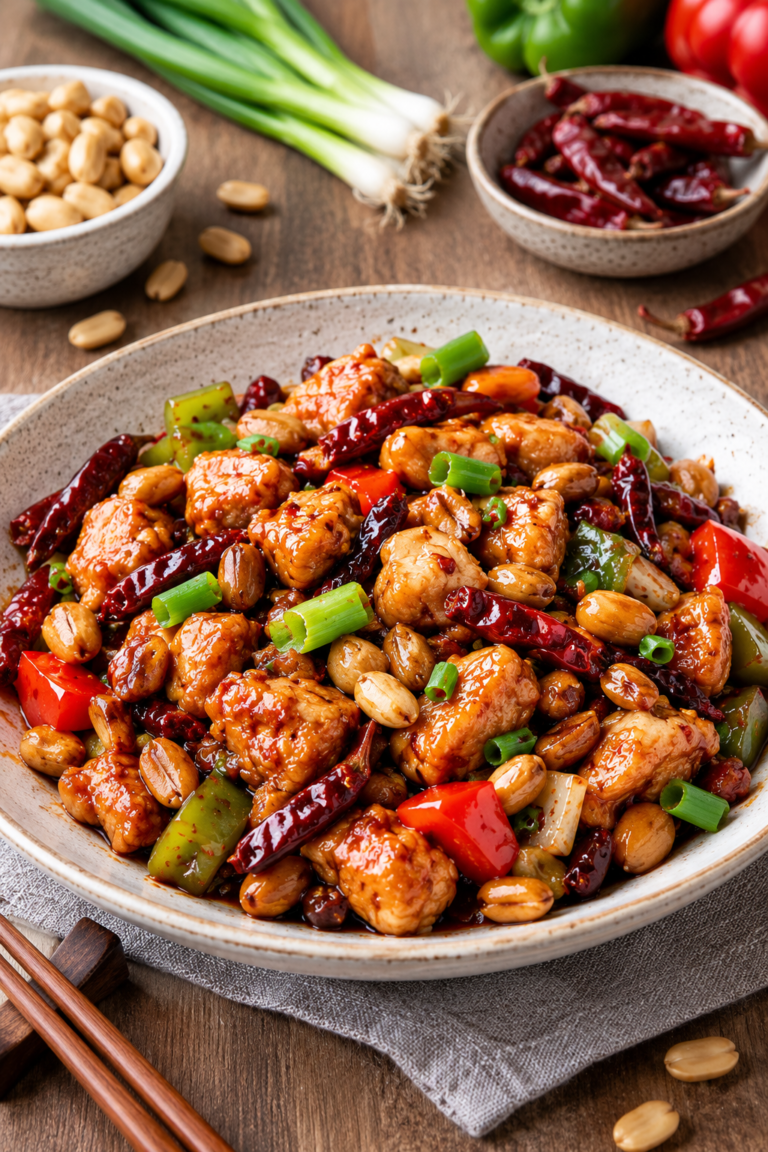
Easy Kung Pao Chicken Recipe: Better Than Takeout in 30 Minutes
This is the friendly, American-style version: hoisin and sugar in the sauce, bell peppers and celery in the mix, and a gentle kick from crushed red pepper. It’s the takeout version many of us grew up on, and once the chicken has marinated, the cooking itself takes just minutes.
Ingredients
For the marinade
- 2 lbs chicken breast, cut into small pieces
- 1/4 tsp salt
- 1/4 tsp peppe
- 2 tbsp soy sauce
- 3 tsp corn starch
- 2 tbsp rice vinegar
For the stir fry
- 3 tbsp vegetable oil
- 4 cloves garlic, minced
- 1/3 cup roasted peanut
- 1 stalk celery, sliced
- 1/2 medium green bell pepper, diced
- 1/2 medium red bell pepper, diced
- 3 stalks green onion, sliced
For the sauce
- 1 tbsp soy sauce
- 1 tbsp hoisin sauce
- 1 tbsp sesame oil
- 2 tbsp sugar
- 2 tbsp white wine
- 2 tbsp water
- 1/4 tsp ground ginger
- 1/4 tsp crushed red pepper
- 1 tbsp corn starch
Instructions
Marinate the chicken
- Put the chicken in a bowl with the salt, pepper, soy sauce, corn starch, and rice vinegar. Mix until every piece is lightly coated, cover, and refrigerate for about an hour. This rest keeps the chicken tender and gives it flavor all the way through.
Whisk the sauce
- While the chicken rests, whisk the soy sauce, hoisin, sesame oil, sugar, white wine, water, ground ginger, crushed red pepper, and corn starch in a small bowl until smooth. Stir it once more just before it goes in the pan, because the corn starch sinks.
Brown the chicken
- Set a wok or large skillet over high heat and add the vegetable oil. Add the marinated chicken and cook until browned and cooked through, then move it to a plate. With 2 pounds of chicken, two batches work better than one crowded pan (use the oil a little at a time).
Stir-fry the vegetables
- In the same pan, add the garlic, celery, and green and red bell peppers. Stir-fry just until they smell wonderful and turn slightly tender while staying crisp.
Bring it together
- Return the chicken to the pan, add the peanuts and green onions, and pour in the sauce. Keep stirring until the sauce thickens and clings to everything.
Serve
- Spoon it over steamed jasmine rice or chewy egg noodles while it’s hot.
Homemade Kung Pao Chicken with tender chicken, crunchy peanuts, and a savory, slightly spicy sauce.
Make it tonight, then tell us in the comments: how spicy did you go, and are you team Kung Pao or team General Tso’s?
Recipe by Sophia · recipeshomely.com